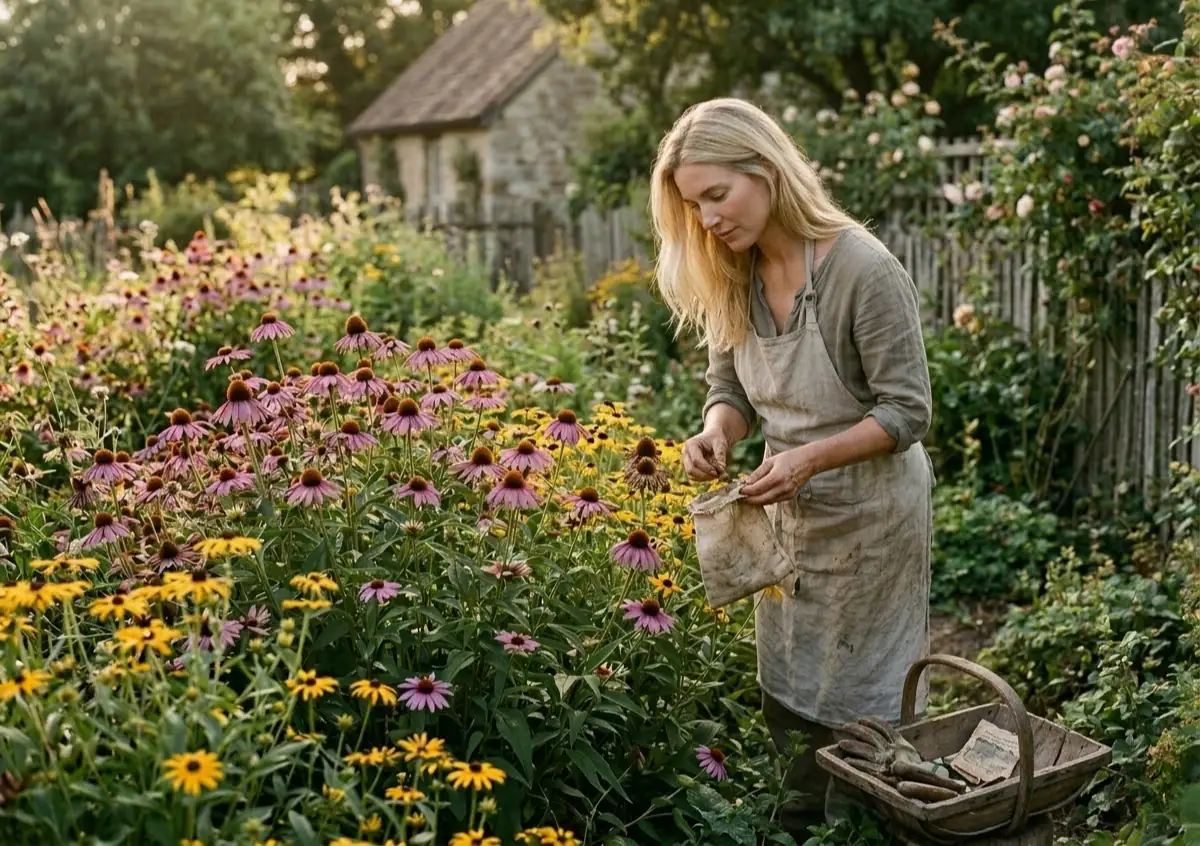
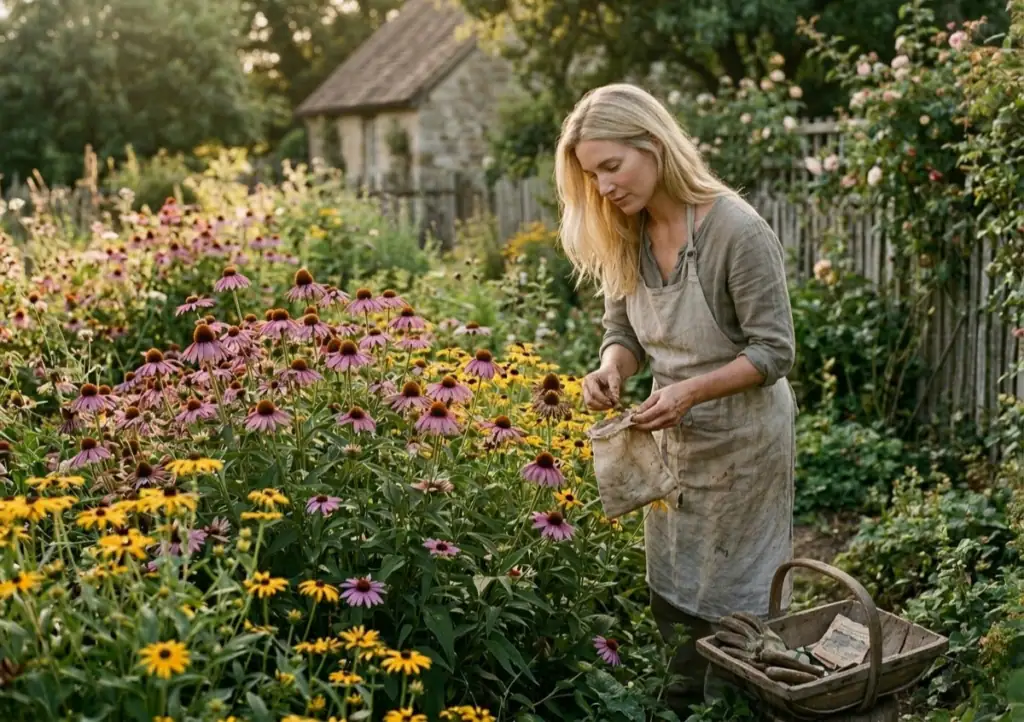
A lush swath of coneflowers and black-eyed Susans provides the perfect foraging ground for local bees.
The Best Flowers for Bees: 10 Plants Your Garden Needs
Want to transform your small homestead gardens into a buzzing paradise? Choosing the best flowers for bees is one of the most impactful things you can do for your local ecosystem, and one of the most rewarding. Whether you have a small patio container garden, a sprawling backyard plot, or a cottagecore garden in the country, planting with pollinators in mind, it’s easy to get started with these 10 ideas.
Why Bees Need Your Help Right Now
Bee-pollinated crops contribute to approximately one-third of the total human dietary supply. PubMed Central Everything from almonds to apples depends at least partially on bee pollination. Honeybees directly or indirectly pollinate our food crops and contribute about $15 billion in increased crop value each year, according to the USDA Agricultural Research Service. Rutgers NJAES
Yet the bees doing that work are under serious pressure. The number of managed honeybee colonies in the U.S. dropped from roughly 6 million in 1947 to less than 2.5 million today. Center for Food Safety
The 2024–2025 season brought the worst losses on record: a national survey estimated that 55.6% of managed honeybee colonies were lost between April 2024 and April 2025, with winter losses exceeding all historical averages since tracking began. Auburn
Beyond managed honeybees, population levels of more than 700 North American bee species are declining due to habitat loss and pesticide use, with nearly a quarter of assessed species at risk of extinction. Time
The good news? Your garden can become part of the solution.
What Makes a Flower Bee-Friendly?
Not all flowers are created equally when it comes to attracting pollinators. Bees perceive color in the ultraviolet range, which is why they are drawn to blooms in shades of white, blue, purple, and yellow; the colors that reflect UV light.
They also gravitate toward plants with fresh, minty aromas and open, shallow blooms that give easy access to nectar and pollen. Plants in the mint family (Lamiaceae) and the daisy family (Asteraceae) are especially popular due to their abundant nectar production and accessible flower structures.
Keep in mind, as you plan your pollinator garden, that it’s important to avoid modern hybrid flowers with doubled or densely packed petals. Plant breeders have sometimes inadvertently removed the pollen, nectar, and fragrance from showier varieties. Stick with heirloom and species-type plants whenever possible.
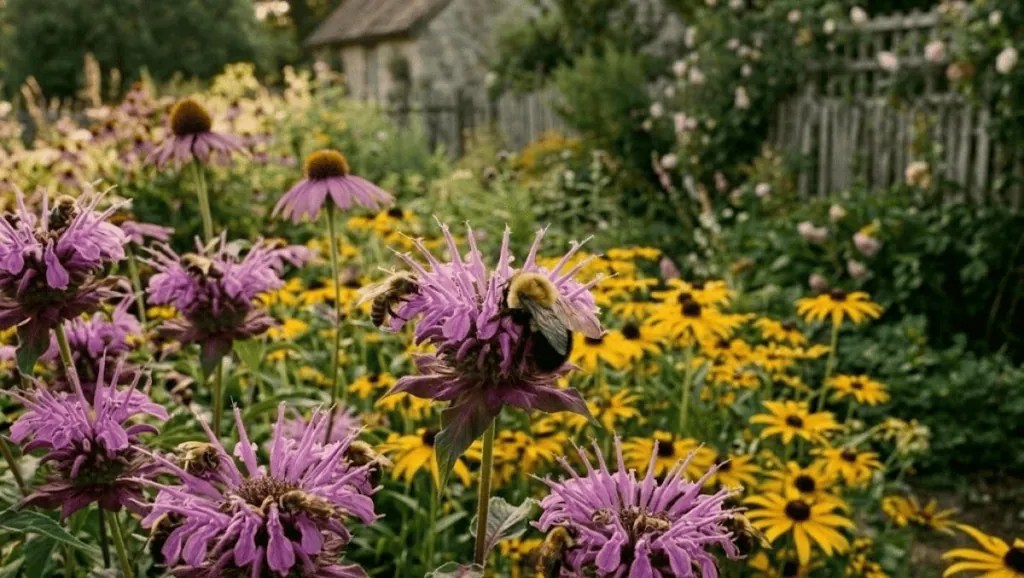
Fuzzy bumblebees are especially drawn to the shallow, nectar-rich blooms of bee balm and other mint family plants.
10 Top Performers for Your Bee Garden
1. Goldenrod (Solidago spp.) Goldenrod earns the top position on ecological importance alone. It is the last pollen source for bees before they overwinter; whatever happens to goldenrod in the fall can be a harbinger of overall bee health and their ability to survive until spring. Smithsonian Insider More than 11 native bee species feed specifically on goldenrod, and more than 100 species are native to North America, blooming from late summer into fall long after most other plants have faded. National Wildlife Federation No other plant on this list has its combination of critical timing and ecological irreplaceability. Despite its undeserved reputation for causing hay fever (ragweed, which blooms at the same time, is the actual culprit) goldenrod is a gentle, insect-pollinated plant invaluable for helping bees build winter reserves.
2. Phacelia (Phacelia tanacetifolia) Phacelia’s raw nectar output is extraordinary and backed by hard data. Phacelia is listed alongside Echium as one of the top five nectar-producing plants in the world, with potential honey yields of 180 to 1,500 pounds per acre and 300 to 1,000 pounds of pollen per acre. Beekeeping & Apiculture Forum Its German common name translates literally as “Friend of the Bees.” The flowers produce nectar continuously throughout the day, and up to 30 bees per square meter have been observed visiting simultaneously on a sunny day. Blogger Often called scorpion weed or fiddleneck, phacelia is widely grown as a cover crop specifically to support pollinator populations. It produces masses of lavender-blue flowers and is a magnet for both native and managed bees.
3.Coneflower (Echinacea spp.) Coneflowers are workhorses of the pollinator garden, blooming from midsummer through fall and attracting everything from honeybees to native bumblebees. Penn State’s multi-year pollinator trial identified Solidago, Echinacea, and Symphyotrichum as the top-performing native genera for overall pollinator visits. Composite specialists, including sunflower bees in the genus Melissodes, depend particularly on coneflower-family plants. They thrive in full sun with minimal water once established. Choose species types over heavily doubled cultivars for maximum pollen production.
4. Borage (Borago officinalis) Borage is listed alongside phacelia, goldenrod, Echium, and lemon balm as one of the top five nectar-producing plants globally. Beekeeping & Apiculture Forum This underused annual produces star-shaped blue flowers that bees find irresistible. It self-seeds freely, blooms for months, and its young leaves and flowers are edible, making it a true dual-purpose cottage garden plant. The bright blue color is particularly attractive to bumblebees, and successive sowings can keep it in bloom from early summer through frost.
5. Catmint (Nepeta spp.) A workhorse of the early-season garden, catmint blooms in late spring and often reblooms in late summer if cut back after the first flush. Its early timing is a key part of its value; it fills the gap between spring bulbs and summer perennials at a moment when many gardens have nothing open. It is extremely drought-tolerant and attracts a wide range of native bee species as well as honeybees. University of Sussex research confirmed high bee visitation rates on catmint relative to other common garden plants.
6. Lavender (Lavandula spp.) While both bumblebees and honeybees are attracted to lavender, the plant is more popular among bumblebees, whose long tongues allow them to efficiently extract nectar from lavender’s tubular flowers. Oregon State University Extension Service. Its fragrant, nectar-rich spikes bloom reliably in early to midsummer, in regions with mild winters, it provides one of the earliest reliable foraging sources of the season. Plant in well-drained soil and full sun. Its early bloom timing and exceptional bumblebee value push it to this position.
7. Bee Balm (Monarda spp.) Also known as wild bergamot, bee balm is a fragrant member of the mint family that produces showy blooms in shades of purple, red, and pink. Its tubular flowers are particularly attractive to bumblebees, which are large enough to access the nectar efficiently. As a native plant, it supports specialist bee species that non-native plants cannot. Penn State’s pollinator trial identified Monarda as one of the top colorful garden plants for pollinator visits, particularly for bumblebee species.
8. Anise Hyssop (Agastache foeniculum) A member of the mint family, Anise Hyssop combines edibility with exceptional pollinator value. Penn State’s Bees, Bugs, and Blooms trial found that Agastache was among the top performers in sustaining pollinator visitation over multiple seasons. Its spikes of blue-purple flowers bloom for weeks in midsummer, and bumblebees, honeybees, and long-tongued native bees actively seek it out. It is drought-tolerant and self-seeds gently without becoming invasive.
9. Black-Eyed Susan (Rudbeckia hirta) This cheerful native wildflower requires very little care and tolerates drought, heat, and even clay soil, all while providing a steady supply of nectar from midsummer through fall. It self-seeds reliably, meaning one planting can become a lasting colony. As a composite flower, it attracts specialist native bees in the daisy family alongside generalist visitors. Its lower ranking reflects slightly less raw nectar production compared to the plants above it, not any weakness as a garden plant.
10. Zinnia (Zinnia elegans) Zinnias are among the easiest flowers to grow from seed and produce non-stop blooms from early summer through frost, attracting a broad spectrum of pollinators, including native bees, honeybees, and butterflies. They rank last not because they underperform, but because they are primarily generalist annuals with lower specialist bee value than the natives above them. Choose single-flowered varieties over pompom types for the best pollen access, as single zinnias outperform doubles significantly for bee visitation.
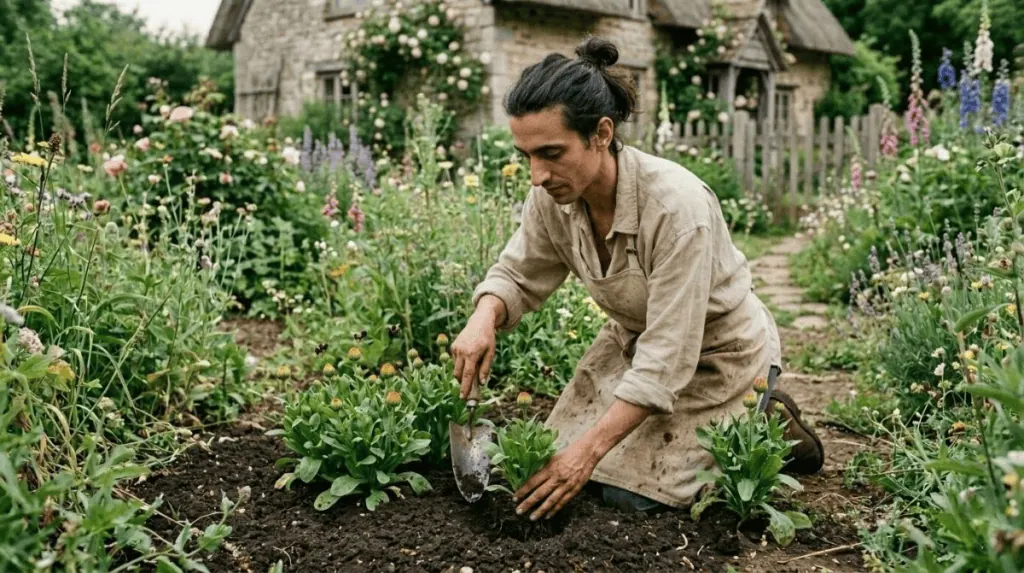
Planting bee-friendly flowers in large clusters helps pollinators forage more efficiently without wasting flying energy.
Planting Tips for Maximum Impact
Plant flowers in swaths rather than scattered single plants. Grouping the same plant species, called planting in drifts, makes it easier for bees to find them and allows foragers to work efficiently without wasting flying energy. Best Bees
To provide food resources throughout the entire period of bee activity, plant a sequence of species that bloom from February through November, since food availability gaps during this window can weaken colonies. Rutgers NJAES
Skip the pesticides whenever possible. If you must treat a pest problem, apply products at night when bees are not foraging and choose the least toxic option available. Your bee-friendly garden will reward you with better vegetable yields, stronger harvests, and the gentle hum of pollinators at work, a sound that signals a healthy, living landscape.
Even a modest planting makes a difference. In the face of record colony losses and ongoing habitat pressures, your small homestead can be a pollinator oasis.
FAQs
What flowers do bees like most in a garden?
Bees are most reliably drawn to open-faced, pollen-rich flowers in the mint family (Lamiaceae) and the daisy family (Asteraceae). Top performers consistently observed to attract the highest bee activity include lavender, bee balm (Monarda spp.), catmint (Nepeta spp.), anise hyssop (Agastache foeniculum), coneflower (Echinacea spp.), black-eyed Susan (Rudbeckia hirta), borage (Borago officinalis), phacelia (Phacelia tanacetifolia), and goldenrod (Solidago spp.).
Herbs, including basil, borage, catmint, chives, lavender, oregano, and rosemary, are highly attractive to honeybees and other pollinators when allowed to bloom and can be interspersed in the vegetable garden to attract them. University of New Hampshire Extension The common thread among all high-performing bee plants is accessibility, shallow or tubular blooms that give bees direct access to nectar and pollen without obstruction. Avoid heavily doubled or ruffled hybrid varieties, which often lack the pollen and nectar that make a flower worth a bee’s time.
A 2024 USDA and Auburn University study assessing native bee preferences in the southeastern United States identified three clear favorites: butterfly weed (Asclepias tuberosa), Indian blanket flower (Gaillardia pulchella), and blue vervain (Verbena hastata), which attracted the greatest abundance and richness of native bee species. USDA Natural Resources Conservation Service
Sources: University of New Hampshire Extension, Pollinator Plants for Northern New England; USDA NRCS / Auburn University, “Recent Report Reveals Native Bees’ Favorite Flowers” (2024), nrcs.usda.gov
What color flowers attract bees?
Bees are most strongly attracted to blue, purple, violet, and yellow flowers, followed by white. This is directly tied to bee vision. Bees see in the range of about 300 to 650 nanometers. They cannot see the color red, but they can see into the ultraviolet spectrum, which humans cannot. NC State News
According to researchers, bees’ favorite colors are purple, violet, and blue. Bees also have the ability to see color much faster than humans; their color vision is the fastest in the animal world, five times faster than humans! Bee Culture
White flowers are also heavily visited, though not for the reason often cited. Bee-pollinated white flowers strongly absorb UV light, which is why they appear as “bee-bluegreen” to bees rather than as white. UV-absorbing white flowers provide strong color contrast against a background of green leaves and match bees’ innate color preferences more closely than UV-reflecting white flowers. PubMed Central
Red flowers, by contrast, are visited primarily by hummingbirds. Red flowers are inconspicuous to red-blind bees unless they also reflect UV light. PubMed Central If you love red flowers and want bee visits, choose varieties that carry UV-reflective patterns; some do attract bees despite appearing red to human eyes.
Sources: NC State University, “What Colors Do Bees See?” news.ncsu.edu; Bee Culture Magazine, “How Bees See and Why It Matters”; Lunau, K. (2025). “Bees, Flowers and UV.” Plant Biology, Wiley. pmc.ncbi.nlm.nih.gov
Do bees prefer native or non-native flowers?
The research on this question is nuanced but points in a clear direction for gardeners. At mature planting sites, wild bee abundance, richness, and diversity were greater on native plants than exotic plants, and wild bees preferred to forage from native plants over co-occurring exotic plants. Honeybees from managed colonies also preferred native plants at mature sites. Wiley Online Library
While generalist bees are more likely to forage on invasive or non-native plant species than specialists, there is abundant evidence supporting generalist bees’ preference for native plant species, suggesting that even generalist bees may be facultative specialists. Frontiers
That said, well-chosen non-native plants remain genuinely valuable. Honeybees visited introduced and native plants at similar rates regardless of floral abundance, while wild pollinator visitation rate decreased more strongly for introduced plants as floral abundance increased, suggesting honey bees and wild pollinators differ in their preferences for introduced versus native resources. PubMed Central
The practical takeaway: build a foundation of native species to support the greatest diversity of native bees, and layer in proven non-native performers such as lavender, borage, catmint, and phacelia to fill seasonal gaps or extend bloom beyond what natives alone can cover.
Sources: Morandin, L.A. & Kremen, C. (2013). “Bee Preference for Native versus Exotic Plants in Restored Agricultural Hedgerows.” Restoration Ecology, Wiley. food.berkeley.edu; Garbuzov et al. (2020), Frontiers in Sustainable Cities, “Assessing Five Decades of Garden Bee Studies.” frontiersin.org; Urbanowicz et al. (2020). “Honey bees and wild pollinators differ in their preference for and use of introduced floral resources.” Ecology and Evolution. pmc.ncbi.nlm.nih.gov
What should I plant to attract bees in spring?
Early spring is the most critical and most neglected season for bee forage. Bumblebee queens emerge from hibernation on the first warm days of late winter, and honeybee colonies begin foraging on mild afternoons weeks before most gardens have anything open.
Native willows, dandelions, ground ivy, and dead nettle are important nectar and pollen sources for many bees, and red maple, though wind-pollinated, will still be used by bees as a food source in early spring. For late fall and early winter, witch hazel may bloom from October through late November and is a source of food for bees still active in colder weather. University of Connecticut Home & Garden Education Center
Crocuses are pretty, easy plants to grow, naturalize easily in your lawn, and bees can be seen flying back to the hive with their distinctive orange crocus pollen from February onward. Habitat Aid
Salvia is a long-blooming perennial whose spires begin in late spring and last through summer even in high heat, humidity, and drought, and lilac is a spring-blooming shrub with huge fragrant panicles that serves as a host plant for the Eastern Tiger Swallowtail and provides an abundance of nectar throughout spring. Butterfly Bushes
If you have lawn space, resist mowing dandelions until other sources are readily available. They are one of the most significant early pollen sources in any landscape and are actively sought by emerging queens that have been without food for months.
Sources: University of Connecticut Extension, “Gardening for Bees,” homegarden.cahnr.uconn.edu; Habitat Aid, “5 Top Plants for Bees,” habitataid.co.uk; ButterflyBushes.com, “12 Early Blooming Pollinator Plants for Spring,” butterflybushes.com
Resources
• USDA Agricultural Research Service: Bee Biology and Systematics: ars.usda.gov
• Apiary Inspectors of America 2024–2025 U.S. Beekeeping Survey: apiaryinspectors.org
• USDA National Agricultural Statistics Service: Honey Bee Colonies Report (August 2025): nass.usda.gov
• Rutgers NJAES, Blooms for Bees: How to Provide Pollen and Nectar Sources: njaes.rutgers.edu
• Center for Food Safety, Pollinator Protection: centerforfoodsafety.org
• Souther et al. (2024), PLOS ONE: Bee and butterfly diversity losses in western and southern North America: doi.org/10.1371/journal.pone.0289742
• Old Farmer’s Almanac: almanac.com
• BBC Gardeners’ World Magazine: gardenersworld.com